


News
10 Things Technical B2B Marketers Need to Know About Google’s New AI Search

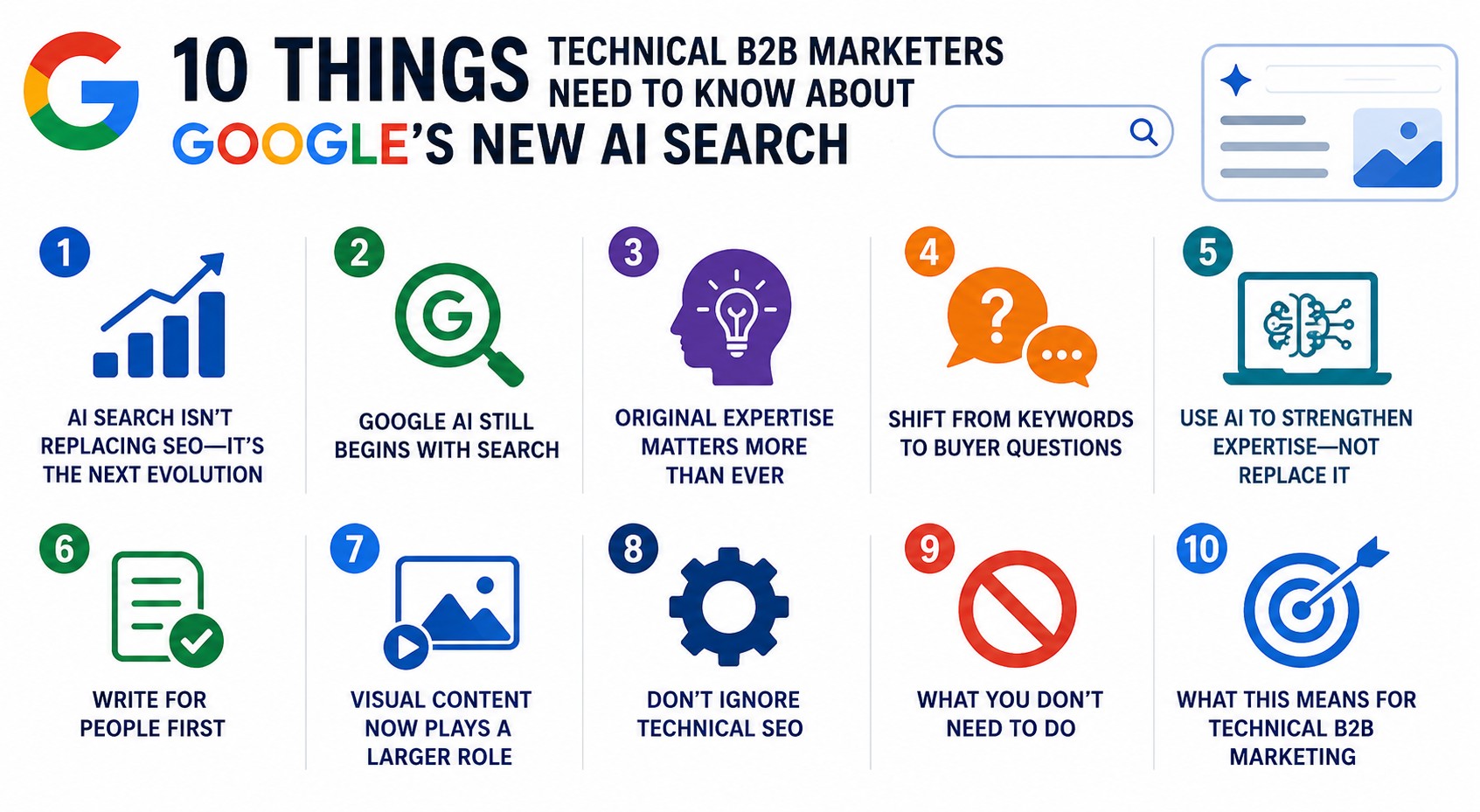
Artificial intelligence has become an indispensable marketing tool. It can accelerate research, organize ideas, analyze performance, and streamline content development. But AI hasn’t replaced the human intuition of marketing. The most effective content still comes from understanding your audience, solving real problems, and communicating with genuine expertise.
Google recently published new guidance explaining how content is selected for AI Overviews and AI Mode. The biggest takeaways are simple:
- AI search isn’t replacing SEO – it represents the next evolution of it
While new terms like AEO (Answer Engine Optimization), GEO, and AI SEO are gaining traction, Google has made it clear that its generative AI search experience still relies on the same core search ranking and quality systems that have driven organic rankings for years.
For technical B2B organizations, this presents an opportunity rather than a challenge. Companies with deep expertise, complex products, and specialized knowledge are exactly the types of businesses Google’s AI systems are increasingly designed to recognize and reference.
2. Google AI Still Begins with Search
Although platforms like ChatGPT, Claude, and Perplexity continue to grow in popularity, Google remains the dominant starting point for online research. For most B2B buyers, particularly engineers, healthcare professionals, manufacturers, and technical decision-makers, that isn’t changing anytime soon.
Google’s AI features use retrieval-augmented generation (RAG), pulling information directly from its Search index to build AI-generated answers with links to supporting sources. It also uses “query fan-out,” where one search triggers multiple related searches to better understand user intent.
Instead of looking for a page that exactly matches a keyword, Google now looks for content that best answers the broader question.
That shift rewards organizations capable of explaining complex topics thoroughly rather than simply targeting keyword variations.
3. The Biggest Change: Original Expertise Matters More Than Ever
Perhaps the most significant phrase in Google’s new documentation is “non-commodity content.”
Google is actively discouraging content that simply repeats what already exists online or could easily be generated by AI. Generic articles offering surface-level information provide little value to either readers or Google’s AI systems.
Instead, Google is prioritizing content that demonstrates:
- First-hand experience
- Subject matter expertise
- Original insights
- Practical application
- Trustworthy information
For technical B2B companies, that’s excellent news.
If your organization designs engineered products, manufactures specialized equipment, develops software, or delivers complex professional services, your greatest competitive advantage isn’t publishing more content; it’s publishing better content.
Companies that explain complicated topics clearly, accurately, and with real-world expertise are increasingly becoming the sources Google chooses to cite.
4. Shift from Keywords to Buyer Questions
Traditional SEO often revolved around creating individual pages for every keyword variation imaginable.
Today’s AI search works differently.
Google understands context, synonyms, and user intent much better than before. Rather than rewarding dozens of nearly identical pages, it increasingly favors comprehensive resources that answer the complete buying journey.
For example, instead of creating separate articles for the same topic, such as Preventative Maintenance. Develop one authoritative guide covering:
- The importance of Preventative Maintenance (PM) for capital equipment
- Advantages and ROI of outsourcing PM agreement renewals
- Differences between Predictive and Preventative Maintenance
This “pillar content” approach not only serves buyers better, but it also aligns with how Google’s AI systems retrieve and synthesize information.
5. Use AI to Strengthen Expertise – Not Replace It
Google isn’t opposed to AI-generated content. In fact, it specifically acknowledges that generative AI can be valuable for:
- Research
- Content organization
- Outlining
- Identifying knowledge gaps
The concern arises when AI is used to mass-produce pages without adding meaningful human expertise. AI should enhance expert knowledge, not replace it.
The strongest workflow for technical marketing remains:
- Interview subject matter experts.
- Capture real application knowledge.
- Use AI to organize and identify missing information.
- Have experienced writers develop accurate, buyer-focused content.
For technical organizations, this produces content that is more accurate, more credible, and ultimately more valuable for both readers and search engines.
6. Write for People First
One consistent theme throughout Google’s guidance is usability.
Google recommends organizing content using:
- Clear headings
- Logical sections
- Short, readable paragraphs
- Helpful tables
- Lists
- Semantic HTML
This isn’t about writing for algorithms. It’s about making complex information easier for people to understand.
Technical buyers appreciate content that includes:
- Definitions of technical terminology
- Real-world application examples
- Product comparisons
- Performance specifications
- Implementation guidance
- Frequently asked questions
- Supporting data and measurable outcomes
The easier technical information is to understand, the more valuable it becomes to both readers and AI search.
7. Visual Content Now Plays a Larger Role
Google also emphasizes that images and videos create additional opportunities for visibility within AI-generated search results.
For technical companies, visuals often communicate concepts far better than text alone.
Consider including:
- Product photography
- Engineering diagrams
- Process flowcharts
- CAD animations
- Installation videos
- Equipment teardowns
- Workflow illustrations
Technical buyers frequently want to see how a product works before they contact a supplier. Today’s visuals aren’t simply conversion assets; they’ve become search assets as well.
8. Don’t Ignore Technical SEO
Despite all the excitement around AI, the technical fundamentals of SEO remain essential.
If Google can’t crawl or index your content, it can’t include it in AI answers.
Your website should continue to prioritize:
- Crawlable HTML pages
- Fast page speed
- Mobile performance
- Logical internal linking
- Clear metadata
- Limited duplicate content
- Appropriate structured data where applicable
Many B2B organizations unintentionally hide their best technical information inside PDFs or downloadable brochures. Publishing that expertise directly on crawlable web pages significantly improves discoverability.
One tool every organization should be using is Google Search Console.
It remains Google’s primary communication channel with website owners and provides invaluable insight into:
- Search performance
- Indexing issues
- Core Web Vitals
- Crawl errors
- Keyword visibility
Surprisingly, many companies still haven’t configured it properly.
9. What You Don’t Need to Do
Google also addressed several common myths surrounding AI search optimization.
You do not need:
- Special AI markup or an llms.txt file
- Dedicated AI schema
- Tiny “chunked” pages designed for AI
- Endless long-tail keyword variations
- A unique writing style for AI systems
- Artificial brand mentions across the web
Google’s AI understands meaning, not just exact keyword matches.
Structured data still supports traditional rich search results, but there is currently no special markup that guarantees inclusion in AI-generated answers.
Likewise, chasing shortcuts or AI “hacks” is unlikely to produce long-term results. The same quality standards that have always mattered continue to matter today.
10. What This Means for Technical B2B Marketing
Google’s AI search raises the standard for content quality.
Generic blog posts, thin landing pages, and mass-produced AI articles are becoming less effective.
Meanwhile, organizations that demonstrate genuine expertise have an opportunity to earn greater visibility than ever before.
For companies selling engineered products, industrial systems, medical technologies, automation solutions, or specialized capital equipment, success increasingly depends on creating content that answers real technical questions with depth, clarity, and authority.
The organizations that will stand out are those that:
- Create original, expert-driven content.
- Answer the questions buyers ask throughout complex purchasing decisions.
- Explain technical concepts clearly.
- Support content with visuals and real-world examples.
- Use AI to improve expert content rather than replace it.
- Focus on quality instead of shortcuts.
The objective is no longer simply earning rankings. It’s becoming the trusted source Google references, and the trusted resource buyers choose when they’re ready to engage.
In the era of AI search, companies that can explain complicated things better than anyone else will continue to have the strongest competitive advantage. For technical B2B marketers, that’s not a new strategy. It’s simply good marketing, reinforced by the next generation of search.
